

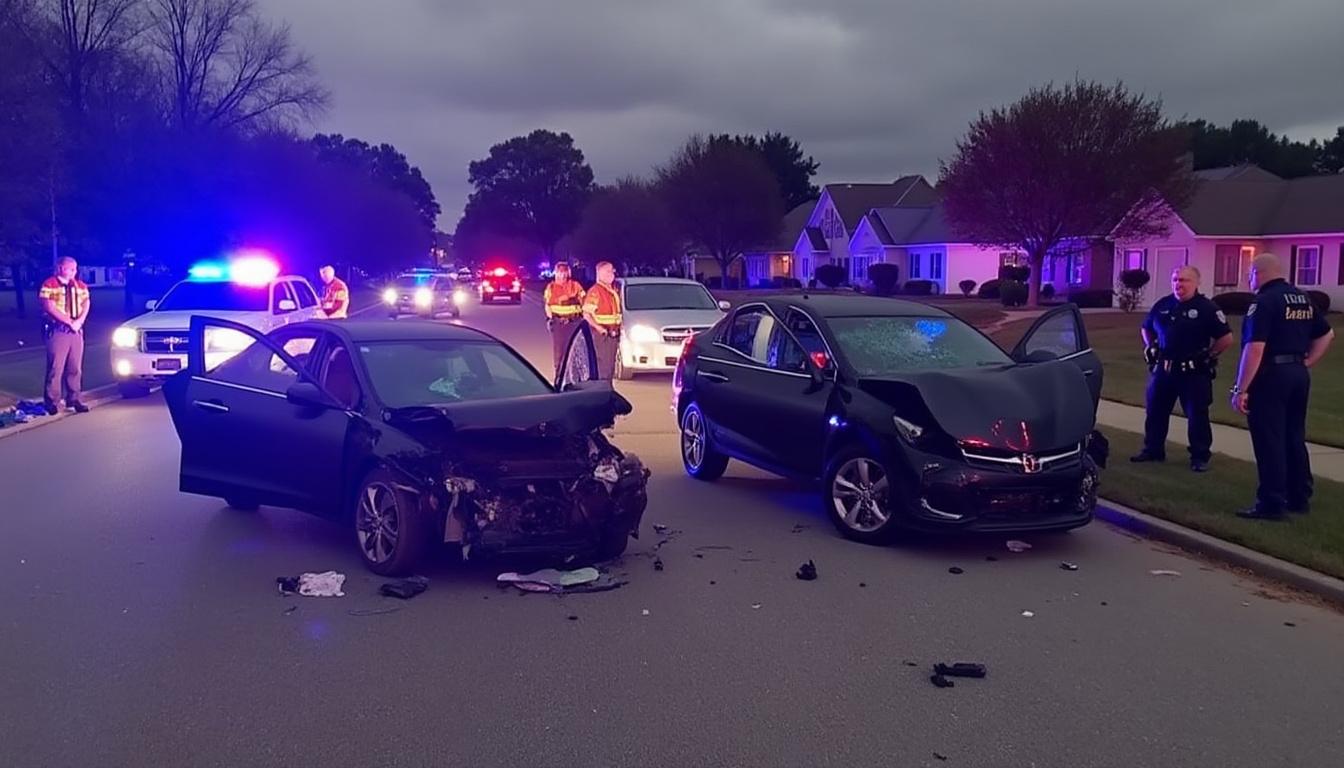
Details of the Fayetteville Collision and the Charges Against a Hope Mills Resident
The deadly collision that upended lives and launched a high-profile criminal case occurred along the All-American Freeway on February 23. Law enforcement reports indicate a 2017 Mercedes‑Benz C300 traveled the wrong way in the northbound lanes toward Fort Bragg and collided head-on with a northbound 2020 Volvo XC90 between Cliffdale and Morganton roads. The vehicle turning into oncoming traffic had its headlamps off, though officers noted they were “occasionally turned on” during the approach.
Officials identified the person taken into custody as Joelle Danielle Sage Outlaw, a Hope Mills resident, who is now formally charged in a case that includes multiple serious counts. The Mercedes passenger, Nealon Alan McNair, 31, of Fayetteville, was pronounced dead at the scene. The Volvo’s driver and passenger were transported to Cape Fear Valley Medical Center with serious injuries, underscoring the deadly nature of the crash.
Local prosecutors filed a total of thirteen counts when presenting the matter before Cumberland County District Court, with eight of those counts alleged as felonies. Charges include second-degree murder, murder of an unborn child, two counts of assault with a deadly weapon inflicting serious injury, two counts of felony death by motor vehicle, two counts of felony serious injury by motor vehicle, driving while impaired, reckless driving with wanton disregard, driving the wrong way, failure to burn headlamps, and failure to wear a seatbelt as the driver.
When the defendant appeared in court before Judge Cheri Siler-Mack, the prosecution emphasized the gravity of the allegations and the community impact of a fatal collision on a major corridor. The detainee is being held without bail in the custody of the Cumberland County Sheriff’s Office pending further proceedings. The filing of these charges marks a transition from an accident investigation to an active criminal prosecution, a shift that brings into focus both legal strategy and investigative depth.
These facts frame the legal and human dimensions of the event: a wrong-way driving incident that resulted in loss of life, serious injuries, and a complex set of criminal charges that prosecutors will need to prove beyond a reasonable doubt. The case carries elements that will draw forensic, medical, and traffic-safety evidence into the courtroom, each playing a pivotal role in the pursuit of justice for victims and their families.
Scene Analysis, Forensic Evidence, and the Ongoing Accident Investigation
Reconstructing how the collision occurred requires a layered approach: traffic investigators combine physical site evidence, witness statements, digital data, and vehicle forensics. Investigators at the scene collected information about skid marks, impact angles, and debris fields to estimate speeds and point of impact. The fact that the Mercedes was observed traveling southbound in the northbound lanes is a critical datum for the probe into fault and potential criminal responsibility.
Forensic teams examine vehicle telemetry, airbag deployment patterns, and structural deformation to quantify forces involved. Those details make it possible to distinguish between unavoidable accidents and reckless or impaired driving. The northbound Volvo’s occupants, including a 29-year-old driver from Hope Mills, were treated at Cape Fear Valley Medical Center for serious injuries; their medical records and treating clinicians’ notes will be part of the evidentiary mosaic.
Investigators also pay close attention to physiological indicators of impairment. Toxicology reports from hospitals and coroners can reveal alcohol or drug presence, and these findings may intersect with charges such as driving while impaired. Because the Mercedes reportedly had its headlamps off intermittently, lighting conditions and visibility become central to understanding driver perception and reaction time.
Witness accounts and digital corroboration
Eyewitness observations often provide initial orientation to an event, but corroboration through cellphone video, dashcams, and traffic cameras can dramatically strengthen investigative conclusions. In this collision, law enforcement sought public assistance and released contact information for tips: anyone with relevant information is encouraged to contact Detective J. Deal at 910-584-3692 or submit anonymous information to Fayetteville/Cumberland County Crime Stoppers at 910-483-TIPS (8477).
Digital evidence can include navigation logs, smartphone location history, or vehicle telematics. These data points help reconstruct speed, lane position, and whether a vehicle crossed medians or entered the wrong lanes intentionally or accidentally. Forensic labs process this information alongside biological samples and mechanical inspections to build a timeline that will be presented to investigators and, later, to prosecutors and defense attorneys.
Medical and scene-based conclusions
Medical examiners and trauma specialists provide insight into causation—how injuries align with crash dynamics. The fatality of the Mercedes passenger highlights the worst outcomes investigators must explain. That medical testimony can bridge the gap between a traffic accident investigation and criminal accountability when evidence suggests culpable negligence or willful misconduct.
Every staged reconstruction, every photograph, and every statement contributes to a larger story the investigative team must tell. This methodical layering of evidence will be essential as the matter transitions from the accident record into a full criminal inquiry, and it signals to the public that the collision is being treated with the seriousness a fatal crash demands.
Legal Trajectory: How the Criminal Case Will Proceed for a Hope Mills Resident Charged with Murder
When a resident is formally charged in a fatal collision, the criminal process advances through a predictable but highly detailed sequence of events. These stages are designed to balance a defendant’s rights with the community’s demand for accountability. The charges brought in this case — including second-degree murder and multiple felony motor vehicle offenses — elevate what might begin as an accident investigation into a lengthy court battle.
At arraignment, the accused is informed of the charges and enters a plea. In the present matter, the defendant was brought before the court on March 31, facing thirteen counts with eight felonies. Being held without bail means the court found sufficient reasons to restrict pretrial release, often due to public safety concerns or flight risk. From that point, the defense and prosecution engage in pretrial discovery, motions, and potential plea negotiations.
Typical stages in a criminal case
- Arraignment and plea entry — the formal reading of charges and immediate plea options.
- Pretrial discovery — exchange of evidence, police reports, and forensic findings between prosecution and defense.
- Pretrial motions — legal battles over admissibility of evidence, suppression hearings, and requests to limit testimony.
- Plea negotiations — the prosecution may offer reduced charges in exchange for a guilty plea, depending on evidence strength and victim-family wishes.
- Trial — if no plea is reached, the case proceeds to trial where a jury evaluates evidence and issues a verdict beyond a reasonable doubt.
Each step involves tactical choices. For example, defense counsel may file motions to exclude certain forensic tests or challenge the chain of custody for toxicology samples. Prosecutors prepare to combine expert testimony—from accident reconstructionists, toxicologists, and medical examiners—with eyewitness accounts and digital evidence to meet the high standard of proof required in criminal trials.
Potential defenses can include lack of intent, medical emergency, or contesting the reliability of impairment tests. However, charges such as murder of an unborn child or felony death by motor vehicle carry severe penalties and require the prosecution to demonstrate specific legal elements, such as a conscious disregard for human life or a culpable mental state linked to the fatal outcome.
An informed public should also note the procedural safeguards: discovery rules, jury instructions, and appellate review ensure that the criminal justice process is thorough and deliberative. The path from arrest to potential sentencing is complex, and each filing, hearing, or plea can reshape the contours of the case. The next phase will determine whether the matter resolves through plea, trial, or alternative disposition.
Community Impact in Hope Mills and Fayetteville: Response, Prevention, and Civic Resilience
A single tragic collision ripples through neighborhoods, workplaces, and local institutions. When a Hope Mills resident is charged in a deadly Fayetteville collision, the incident becomes both a criminal case and a communal moment of reckoning. Families mourning a lost loved one, injured survivors recovering in hospital wards, and neighbors seeking explanations all figure into the broader social aftermath.
Local leaders and public safety officials often respond with outreach and policy reviews. Traffic corridors where major incidents occur may be reassessed for signage, lighting, and enforcement presence. Community groups may call for targeted campaigns against impaired and wrong-way driving, leveraging both public education and stricter patrols to enhance safety.
Hope Mills and Fayetteville share a commuter corridor influenced by Fort Bragg’s presence, creating unique patterns of traffic, including high volumes at shift-change times. Emergency services, hospitals, and victim assistance programs are part of the support network activated after such an event. Public meetings, victim advocacy resources, and municipal reviews of road safety measures often follow to address both immediate needs and long-term prevention.
Community actions and resources
- Increased traffic enforcement and targeted DUI checkpoints in high-risk corridors.
- Public safety campaigns emphasizing wrong-way prevention and proper use of headlamps at night.
- Support services for victims’ families including counseling and victim-advocate liaison programs.
- Infrastructure reviews of lighting, median barriers, and signage at identified danger spots.
- Partnerships with local media and outreach programs to encourage anonymous tips to law enforcement.
Public interest in true-crime narratives remains strong, and that cultural fascination can be channeled constructively. For those looking to contextualize how criminal investigations and media coverage intersect, a resource that discusses storytelling around criminal cases can be informative, such as a feature on a well-known true-crime series overview. Responsible journalism and careful reporting help maintain factual clarity while respecting those affected.
Community resilience is evident when citizens, public officials, and advocacy organizations collaborate to reduce the risk of future tragedies. The civic conversation that follows a fatal accident often produces concrete improvements—improved signage, better lighting, and renewed enforcement—that save lives in the years after a collision. This momentum underscores the potential for systemic change when a community demands safer streets and accountability.
Prevention, Policy Lessons, and How the Ongoing Investigation Shapes Future Safety Measures
Every investigation into a deadly collision yields lessons that can inform policy and prevention. The combination of human behavior, vehicle mechanics, roadway design, and enforcement policy is the arena where meaningful interventions take place. The case in which a Hope Mills resident is charged with murder after a wrong-way crash prompts a renewed focus on both immediate enforcement and strategic planning to prevent similar tragedies.
Technological upgrades can reduce wrong-way incidents. Examples include wrong-way detection systems that trigger dynamic signage and alerts to approaching drivers, as well as improved highway lighting and reflective pavement markers that clarify lane orientation. Where headlamp misuse is implicated, public education campaigns highlighting safe lighting practices and the legal requirements for vehicle lighting at night can address common failure points.
Law enforcement agencies also examine procedural changes. Enhanced training for quickly recognizing and intercepting wrong-way motorists, better use of radar and patrol deployment, and rapid dissemination of alerts to neighboring jurisdictions can reduce the window of collision risk. Municipal planners may evaluate access points and interchanges to minimize confusing turns that occasionally lead to dangerous maneuvers.
| Intervention | Expected Benefit | Implementation Example |
|---|---|---|
| Wrong-way detection systems | Early alerts to drivers and authorities | Dynamic signage with radar-triggered warnings |
| Improved roadway lighting | Better visibility reduces lane confusion | LED corridor lighting upgrades near interchanges |
| Targeted enforcement | Deterrence of impaired or reckless driving | Periodic sobriety checkpoints and patrol surges |
Community members are encouraged to participate in prevention by staying informed and reporting suspicious driving behavior. Anonymous tip lines such as Crime Stoppers allow citizens to contribute without fear of retaliation. For those following developments in high-profile criminal cases or studying how investigations inform policy, further context can be found in media explorations of investigative storytelling, such as a piece on a popular true-crime podcast and series, which illustrates how narratives influence public perception.
The ongoing investigation will continue to inform prosecutors, engineers, and community leaders. Evidence gathered now will influence courtroom outcomes and policy recommendations later. That dual trajectory—justice for victims and practical improvements to road safety—is the vital payoff when rigorous investigation meets civic will. The key insight: thorough inquiry produces both accountability and the constructive change necessary to prevent the next tragic collision.