

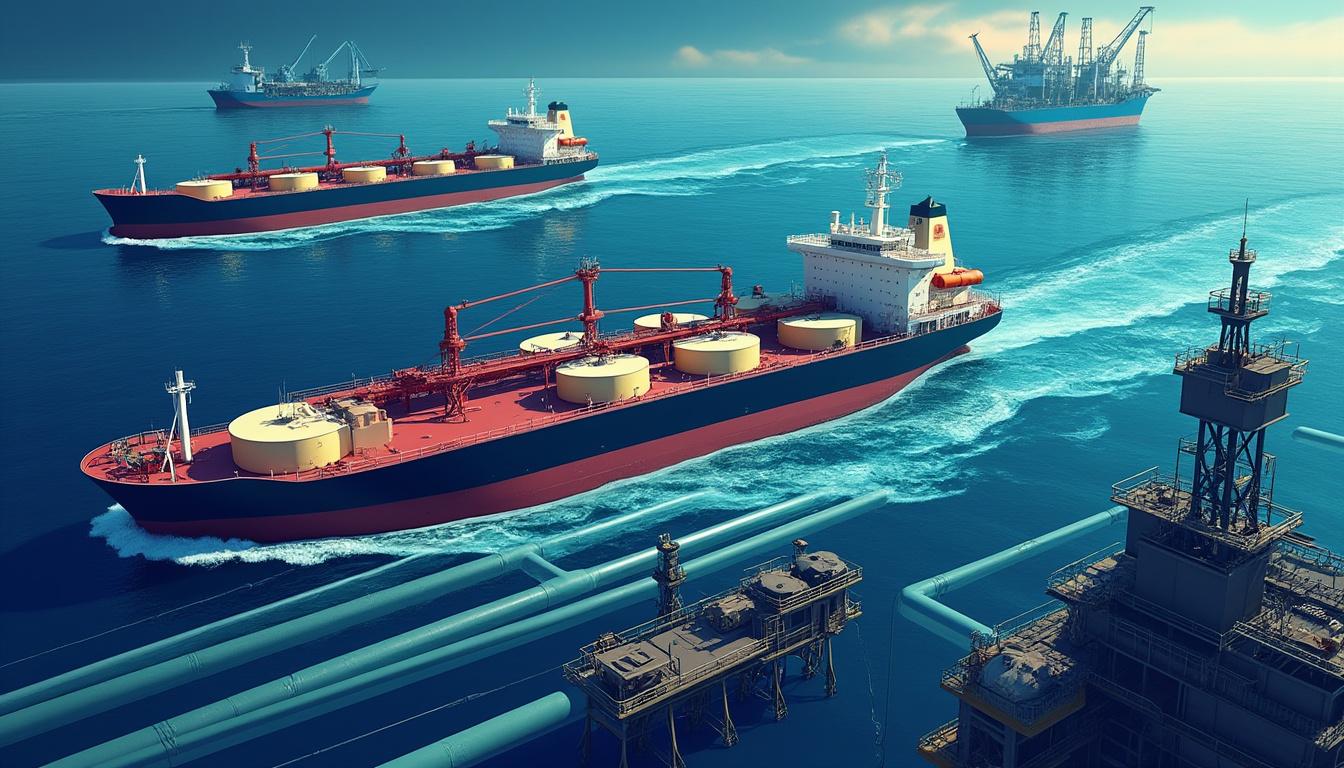
Why Global Natural Gas Markets Are More Challenging Than Oil Today
The contemporary landscape of global natural gas reveals a set of structural asymmetries that make it inherently more complex than oil. Unlike crude, which benefits from long-established maritime logistics, deep liquidity, and a relatively uniform set of demand uses, natural gas is constrained by delivery mode, seasonality, and localized market mechanisms. These differences produce distinct market challenges that ripple across finance, trade, and geopolitics.
First, the physical characteristics of gas favor either pipeline networks or liquefaction for long-distance transport. Building a pipeline requires sustained diplomatic alignment and capital commitment, while liquefaction and regasification terminals demand high upfront costs and long lead times. Those hardware realities feed into the market through limited short-term flexibility, amplifying price moves when demand patterns shift.
Second, demand patterns for gas diverge strongly from oil. Oil remains dominant in transport and is traded globally with ease. Natural gas is primarily used for power generation, industrial heat, and residential heating, creating strong seasonal swings and regional demand spikes. This uneven demand profile increases exposure to sudden cold snaps, heat waves, or industrial cycles that can drive price volatility more sharply than in oil markets.
Comparative drivers: oil comparison and gas-specific frictions
Oil markets benefit from a global floating storage network: tankers, arbitrage, and standardised contracts. Natural gas lacks that degree of fungibility. Liquefied natural gas (LNG) creates new interconnections, but infrastructure constraints and shipping capacity limit the speed at which supply can rebalance global mismatches. The result is that supply disruptions, even if localized, can have outsized effects on prices in import-dependent regions.
Third, pricing regimes differ. Oil benchmarks such as Brent have become universally referenced; many gas contracts remain indexed to local hubs or even to oil indexes in long-term contracts. This fragmentation complicates hedging strategies and creates multiple price vectors that traders and policy makers must monitor. As a consequence, trading desks and sovereign buyers face higher execution risk and more complicated risk management than in the crude market.
Examples and case studies
Consider a hypothetical company, Aquila Gas Traders, which sources cargoes for European utilities. When a cold snap in Northern Europe raises demand, Aquila must secure cargoes from multiple suppliers across Asia and North America. Shipping windows, terminal slot availability, and fuel costs for tankers all constrain quick action. By contrast, a refinery facing higher oil prices can tap global crude supplies more fluidly.
Real-world history reinforces this point. The disruption of pipeline flows from a major supplier quickly cascaded into emergency procurement and high spot prices in 2022, reshaping contracting behavior for years. Since then, markets have become more febrile: the interplay of geopolitical decisions and limited spare regas capacity keeps margins thin and volatility high.
Finally, policy and climate debates layer extra complexity. The energy transition creates competing demands for gas: as a backup for intermittent renewables, as a feedstock for hydrogen production, and as a bridge fuel to lower-carbon systems. These emerging roles change long-term investment signals, while near-term supply constraints influence policy urgency and market pricing.
Key insight: The marriage of physical delivery challenges, seasonal and sectoral demand swings, and fragmented pricing systems makes global natural gas inherently more difficult to manage than oil, and these challenges feed directly into the broader volatility of energy markets.
How LNG and Infrastructure Constraints Reshape Energy Markets
The proliferation of LNG has been the principal force pushing natural gas toward a more globalised market structure. Yet, while LNG brings new trade flows, it also surfaces a web of infrastructure constraints that shape supply responsiveness and commercial behavior. These constraints are technical, economic, and geopolitical, each limiting the speed at which markets can rebalance.
Technically, the liquefaction and regasification chain is capital-intensive and slow to expand. FID (final investment decisions) for new LNG trains often require a decade from conception to operation, and any delay in permitting, financing, or construction can narrow the global spare capacity cushion. Shipping is another chokepoint: the global fleet of LNG carriers grew rapidly in recent years, but mismatches between vessel availability and terminal slot timing can produce costly delays.
Economically, the sunk costs and long-term contracts that underpin many import and export terminals create contractual rigidity. Buyers frequently sign take-or-pay clauses to secure capacity, which can reduce the volume of gas available on the spot market during tight periods. These contractual frameworks stabilize investment but limit short-term flexibility, and that tension is felt in price outcomes.
Operational constraints and storage limitations
Storage capacity matters profoundly for a commodity with pronounced seasonality. Regions that lack ample underground storage face higher risk during winter peaks. Those areas must compete on the spot market for cargoes or rely on quick-turn pipeline shipments. Building storage is expensive and politically sensitive, so many markets remain vulnerable to extremes.
Examples traceable to field operations illustrate the issue. A sudden outage at a liquefaction plant or a weather-related delay in a shipping lane can remove millions of cubic meters from the available global pool for weeks. The time-sensitive nature of such disruptions means that even modest supply-side shocks can amplify price volatility across continents.
To clarify the specific constraints at play, consider the following list of core infrastructure bottlenecks:
- Liquefaction capacity shortages in exporting regions that delay cargo availability.
- Regasification terminal slot constraints at importing ports limiting intake rates.
- Shipping bottlenecks and uneven carrier deployment across trade routes.
- Underground storage deficits in seasonal import markets.
- Interconnector limitations between regional grids and markets reducing cross-border flows.
These bottlenecks are not isolated; they interact. For example, limited regas slots can cause ships to idle offshore, increasing costs and delaying cargo rotations. That additional cost is often passed through to buyers, increasing the effective price of supply in times of stress.
Policy responses vary. Some governments incentivize expedited terminal buildouts or offer public financing for strategic storage. Others focus on diversifying supplier basins to reduce reliance on single-source pipelines. The effectiveness of these measures depends on long-term planning and the ability to coordinate across jurisdictions and private capital providers.
Key insight: While LNG is a tool of globalisation, the physical pipeline of terminals, ships, and storage imposes friction that turns what might have been rapid market corrections into prolonged episodes of elevated prices and uncertainty.
Price Volatility, Geopolitical Risks, and the Fragile Balance of Supply
Price dynamics in the gas market are tightly bound to geopolitics. Decision-making in one region can have immediate knock-on effects in others because the pool of flexible supply is limited. This coupling produces a market environment where geopolitical risks are not mere background noise but core drivers of daily price formation.
Major disruptions—whether from conflict, sanctions, or diplomatic standoffs—can rapidly remove pipeline capacity or restrict exports. The market reaction to such events is magnified by the limited spare capacity of both liquefaction and shipping. Hence, what would be a manageable swing in oil markets becomes a protracted crisis in gas markets.
Hedging strategies help but are imperfect. Financial contracts and gas-on-gas trading at hubs provide tools to manage exposure, yet liquidity in many regional hubs remains thinner than in oil. That creates bid-ask spreads and execution risk that amplify costs for utilities and industrial consumers when volatility spikes.
Examples from recent history and implications for 2026
Recent years demonstrated how quickly the landscape can change. Supply realignments and sanctions led to differentiated price paths across continents, while the ramp-up of new LNG capacity began to ease some tensions. Yet, even as incremental supply arrived, market sentiment remained fragile because investment cycles were long and demand patterns were shifting.
For national policy-makers, the lesson is stark: energy security now requires not just fuel stocks but also diplomatic agility. Trade wars, shipping interdictions, or a sudden export ban can force importers to scramble for alternative cargoes, at times paying significant premiums to secure supply.
Financially, price volatility affects capital allocation. Investors factor in wider risk premia when financing new projects, often demanding higher returns to compensate for geopolitical uncertainty. Those higher costs ultimately feed back into the price paid by consumers and can slow the pace of new capacity additions.
To illustrate, imagine a mid-sized utility called Voyager Energy Trading tasked with keeping a coastal grid stable. When a political crisis cuts a major pipeline, Voyager pivots to spot LNG purchases. The combined cost of expedited shipping and premium cargo prices forces difficult trade-offs between passing costs to customers or curtailing non-essential consumption. In both scenarios, the social and economic impacts are immediate.
Key insight: The interplay between geopolitics and constrained flexibility in gas supply makes price spikes deeper and longer-lived than comparable shocks in oil markets, changing the calculus for governments and market participants alike.
Demand Dynamics: Why Natural Gas Demand Reacts Differently Than Oil
Understanding natural gas demand requires disaggregation by end-use. Gas serves power generation, residential heating, industrial heat, and feedstock roles. These varied applications create distinct demand elasticities and timing sensitivities, so a single shock rarely touches all sectors equally. This fragmentation differentiates gas from oil and complicates forecasting.
Power generation demand is often weather-driven and shows strong daily and seasonal cycles. Residential heating concentrates demand during cold months, creating large winter peaks in northern climates. Industrial consumption, meanwhile, can be inflexible; a chemical plant cannot quickly switch to alternative feeds without costly retrofits. This blend produces both recurrent seasonality and large asymmetric shocks when a large sector faces a disruption.
Moreover, the energy transition interacts with demand in complex ways. As renewables expand, gas frequently occupies a peaking and balancing role, increasing the premium on flexible supply. Simultaneously, policies to decarbonise industrial heat create uncertainty about long-term demand trajectories, complicating investment in new gas infrastructure.
Regional demand stories and long-term trends
Asia exemplifies rapid demand growth driven by industrialisation and rising power needs. Import dependence is high in several countries, making Asian buyers key marginal players in the global LNG market. Europe, having reconfigured after major supply disruptions, now focuses on diversified sources and greater storage. North America, with abundant shale resources, behaves differently: local price outcomes often diverge from global trends.
To visualise the changing landscape, review this compact table comparing structural aspects of gas and oil demand:
| Dimension | Natural Gas | Oil |
|---|---|---|
| Main end-uses | Power, heating, industry, feedstock | Transport, petrochemicals, industry |
| Seasonality | High (winter/peak demand) | Lower (more even year-round) |
| Transport mode | Pipelines and LNG (inflexible) | Tankers (highly fluid) |
| Price formation | Hub-based, regional, oil-linked contracts | Global benchmarks (Brent, WTI) |
These contrasts illuminate why policies for resilience in gas markets often differ from those for oil. For example, managers of electricity grids must factor in gas-fired plant availability and storage, while transport fuel shortages have historically been mitigated by global tanker flows.
Travelers and analysts alike observe underlying supply-demand structures during field visits. A technical team visiting an LNG import terminal can see firsthand how limited berthing slots generate a queue of tankers—a physical manifestation of market tightness. Those on-the-ground observations shape procurement strategies and long-term contracting.
Key insight: The sectoral composition and seasonal character of natural gas demand produce market behaviors that are more volatile and regionally fragmented than oil, requiring bespoke approaches to resilience and investment.
Strategies to Address Market Challenges in Global Natural Gas
Managing the complex risks of global natural gas requires an integrated strategy spanning policy, commercial, and technical measures. Successful approaches blend immediate operational fixes with long-term structural reforms. Case studies and hypothetical examples show how actors can reduce vulnerability while supporting the energy transition.
On the policy front, diversification of supply sources is central. Countries that developed multiple pipeline links and LNG terminals now face fewer abrupt shortages. Strategic storage mandates and incentive schemes for capacity build-out help smooth seasonal peaks. Regulatory clarity around capacity allocation and third-party access reduces bottlenecks and fosters market participation.
From a commercial standpoint, contract innovation matters. Portfolio buyers increasingly combine long-term anchor contracts with flexible spot exposure and short-term swapping arrangements. This blended approach allows firms to secure baseline volumes while retaining optionality to exploit lower prices. Financial instruments—range options and structured swaps—help manage exposure to price volatility.
Technical responses and investment priorities
Infrastructure investment remains crucial. Expanding regas capacity, modernising pipeline networks, and increasing storage are all salient measures. Investment decisions should align with decarbonisation pathways: for instance, designing terminals to be hydrogen-ready or compatible with bio-LNG can reduce long-term stranding risk.
Practical tactics for market actors include demand-side management programs and coordinated procurement consortia. Utilities can stagger deliveries, invest in demand response, and coordinate with neighbouring systems to share reserves. Traders can prioritise cargo scheduling economies and secure flexible charter agreements to mitigate shipping constraints.
To ground these ideas, consider the hypothetical firm Voyager Energy Trading again. Voyager adopted a three-pronged plan: diversify supply baskets, invest in short-term storage, and enter into flexible shipping contracts. When a regional disruption occurred, Voyager’s diversified cargoes and storage allowed it to smooth customer deliveries without excessive premium purchases. That operational resilience translated into saved contingency costs and stronger commercial reputation.
Behavioral elements matter as well. Transparency in reporting, real-time monitoring of flows, and coordinated contingency playbooks among utilities, regulators, and suppliers reduce panic-driven bidding and destructive market swings. Experience shows that markets with robust information networks suffer fewer price spikes and reallocate resources more efficiently.
Finally, the traveler’s perspective can be instructive. Observations from port towns, terminals, and industrial clusters provide tactile intelligence about equipment condition, berth utilisation, and local labour readiness. These insights occasionally reveal early signals of impending bottlenecks that models might miss.
Key insight: A combination of diversified sourcing, flexible contracting, targeted infrastructure investment, and operational transparency can materially reduce the vulnerability of gas systems and improve outcomes across energy markets.
For further cultural context and travel insights that inform a worldly perspective on energy hubs, see a practical exploration of urban food and logistics culture in Tokyo at Tokyo food and drink scene and an observation of coastal infrastructure while visiting ocean-facing ports noted in best beaches in Portugal.
Final thought: Strategies that combine technical resilience, commercial flexibility, and informed policy will be essential to tame the distinctive market challenges that make global natural gas harder to manage than oil.