

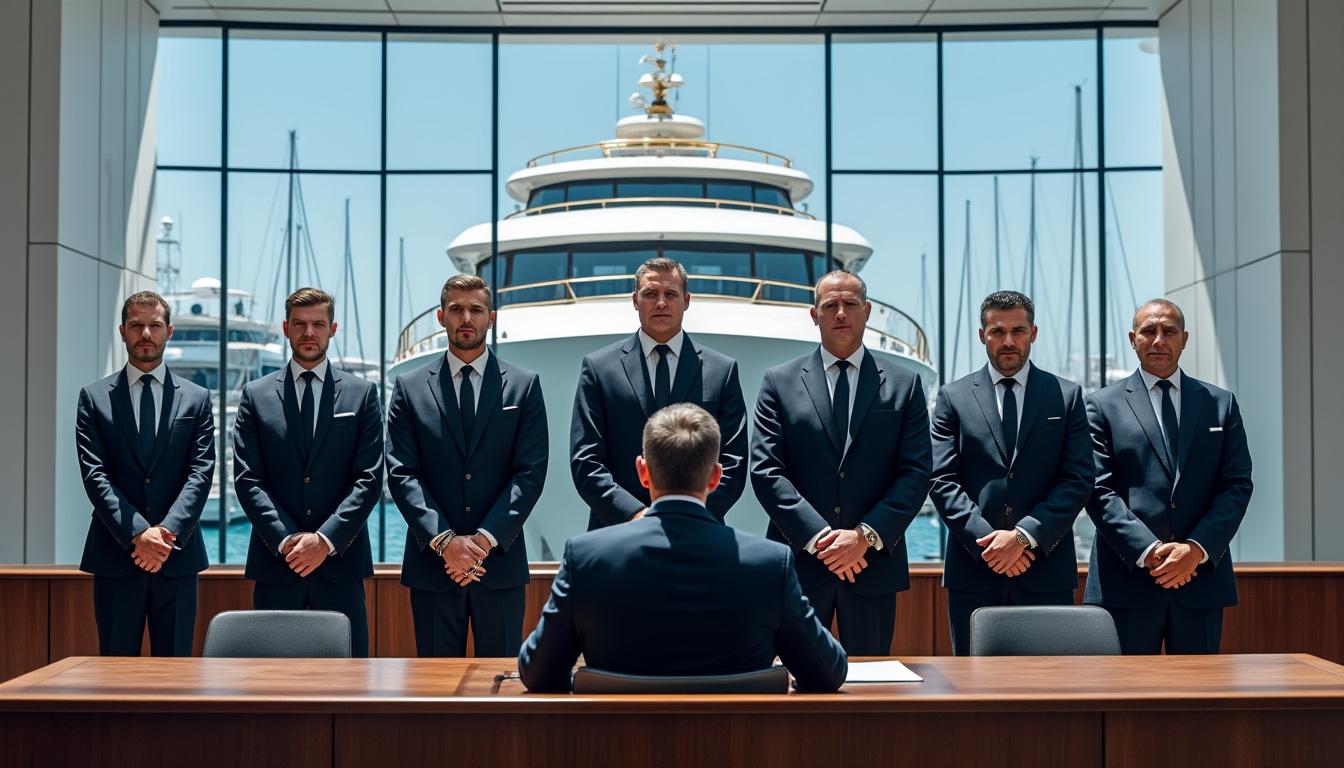
Court Sentencing Highlights Luxury Yacht Human Trafficking Operation
The recent court sentencing of two men linked to a high-end maritime smuggling scheme has cast a harsh light on how a seemingly glamorous vessel can mask brutal criminal activity. In a Portsmouth Crown Court ruling that resonated through law enforcement circles, two Ukrainian nationals were sentenced after admitting to assisting unlawful immigration by ferrying migrants aboard a $20,000 vessel identified as Uforia. The judgment followed a coordinated interception by Border Force and the National Crime Agency (NCA) on 20 July 2025, when the yacht was stopped near the Isle of Wight.
Court documents and testimony established that the pair, aged 38 and 43, made at least eight separate crossings across the English Channel, transporting groups that at times included whole families and vulnerable individuals. The judge characterised the enterprise as an insidious marketplace: an advertised smuggling service pitched as a premium, low-risk option for desperate migrants who had saved or borrowed significant sums—reports indicate fees of up to 16,000 euros per passenger in some instances.
Details of the Case and Judicial Reasoning
Prosecutors painted a picture of an operation that blended maritime know-how with criminal coordination. Witness statements and intercepted movements linked the men to an organised pattern of activity that law enforcement assessed as part of a wider criminal network. Evidence included repeated voyages to small harbours, attempts to evade radar, and refusal by the defendants to provide access to mobile devices during questioning.
A judge delivering the sentence described the transport of a lone, young Vietnamese girl onboard as particularly callous. While age details were withheld in court records, the child was placed into foster care. Another passenger, an Albanian man, was arrested for unrelated charges and subsequently deported. The court emphasized that facilitating such clandestine entries not only broke immigration laws but also increased the risk of victims falling prey to modern slavery and exploitation.
The verdict and penalties send a clear message: maritime smuggling using a luxury yacht is treated with the same gravity as any organized trafficking endeavor. The sentences reflected not only the immediate illegal acts but the broader public harm—families drained financially, children placed at risk, and ports exploited as entry points beyond typical monitoring channels.
Key judicial observations highlighted the operational model: a premium-fee structure, exploitation of private marinas, and a chain of actors extending beyond the two men on trial. That framing informed the court’s decision to issue custodial sentences intended to deter similar schemes and aid dismantling the wider network.
Insight: The sentence underscores that apparent luxury on the water can conceal severe criminality and that effective prosecution requires both maritime vigilance and interagency coordination.
Anatomy of a Luxury Yacht Smuggling Service and Maritime Smuggling Tactics
Understanding how a luxury yacht becomes a tool for human trafficking requires dissecting both the logistical mechanics and the social dynamics that make the service viable. At its core, such operations exploit gaps in surveillance: small ports, private marinas, and after-hours moorings provide cover. The vessel used in the noted case, Uforia, served as a mobile escape route—small enough to slip into secluded harbours, yet robust enough to cross the Channel repeatedly.
Operators adopt a suite of tactics to lower risk and increase profit. These include careful timing to avoid peak patrol periods, using decoy trips to mask real crossings, and leveraging local knowledge of tides and harbour access. Smugglers may offer what they call a ‘premium’ service—a promise of discretion and comfort that attracts clients willing to pay high sums. The reality behind that marketing is overcrowded cabins, minimal safety gear, and no legal recourse for passengers once the journey is in motion.
Operational Components and Examples
Below is a condensed breakdown of typical elements found in an organized maritime smuggling setup, informed by recent cases across Europe and beyond.
- Vessel selection: Yachts and motor cruisers are chosen for speed and inconspicuousness.
- Route planning: Small harbours and alternate landings are preferred to avoid major port scrutiny.
- Financial model: High-per-passenger fees; sometimes payments split across intermediaries.
- Network links: Collaboration with onshore handlers to arrange pickups and accommodation.
- Risk mitigation: Use of encrypted communications and layers of intermediaries to insulate leaders.
Examples from recent investigations illustrate these elements. The intercepted Uforia crossing in July 2025 involved clandestine entry into Haslar Marina, while other documented cases show routes ranging from eastern Mediterranean landings to crossings nearer to the French coast. In several instances, authorities uncovered evidence that individual operators were part of larger transnational groups, coordinating movement across multiple countries and vessels.
Operatives often position themselves as service providers catering to migrants who might otherwise undertake more dangerous or exposed routes. That mischaracterization—selling criminality as convenience—magnifies the ethical breach. Migrant clients are rarely protected; instead, many find themselves in vulnerable positions, indebted and exposed to violence or exploitation once smuggled.
Insight: The operational anatomy of a yacht-based smuggling service blends maritime skill, local knowledge, and a market-driven exploitation of vulnerability, making dismantling such operations as much about intelligence and social policy as about policing.
Law Enforcement Response and the Challenge of Disrupting Criminal Network Activity
When maritime smuggling crosses into organized illegal trafficking, response must be multi-layered. The seizure of Uforia exemplifies coordinated action: a tip-off from French authorities triggered an NCA request, leading Border Force to intercept the yacht. Such international collaboration is increasingly the norm as criminal networks span borders and exploit jurisdictional blind spots.
Law enforcement agencies confront several obstacles. First, data collection often focuses on the narrowest Channel crossings logged by government statistics, leaving a blind spot for entries via smaller harbours and private marinas. Second, suspects denying access to phones and refusing cooperation can slow investigations. Third, the profit-driven nature of these networks means actors quickly adapt routes and tactics when detection increases.
Case Comparison Table: Maritime Smuggling Incidents and Outcomes
| Date | Vessel | Operator Nationality | Passengers | Outcome / Sentencing |
|---|---|---|---|---|
| 20 July 2025 | Uforia | Ukrainian | 4 adults + 1 child | Two jailed; passengers in asylum process / foster care |
| April 2024 | Unnamed luxury yacht | Albanian | 21 migrants | Operator jailed 7 years |
| 2022–2022 (ongoing) | Sailing yachts network | Various | 2000+ (estimated) | Investigations; sanctions and arrests |
In response, agencies have broadened tactics: financial tracking to interrupt payments, port-level intelligence to flag suspicious bookings, and targeted surveillance of known marinas. The Treasury’s sanctions in previous years against members of smuggling networks demonstrated that financial pressure can augment criminal investigations.
Cooperation with NGOs and social services is also crucial. When victims are identified—especially minors or those at risk of exploitation—rapid referral to protective services helps prevent re-victimization and supports prosecution by ensuring testimonies are gathered safely.
Insight: Disrupting maritime organized crime requires synchronized action across borders, finance, and social protection systems to break the economic incentives that sustain these networks.
Human Impact: Victims’ Stories and the Cost of Illegal Trafficking Via Yacht Routes
Beyond headlines and court rooms, human lives are profoundly affected by maritime smuggling. To anchor the narrative, consider a composite character—call her Nadia. Nadia paid a large sum after being promised a discreet crossing to join family in the UK. The journey on a vessel similar to Uforia was cramped and unsafe; once ashore, she discovered the price paid bought neither security nor legal status. Nadia’s story echoes many real-life accounts: financial ruin, separation from kin, and prolonged legal uncertainty.
Another personal anecdote reflects the plight of the Vietnamese girl intercepted aboard Uforia. Found alone and frightened, she was placed into foster care while officials sought to clarify her circumstances and provide protection. Such cases highlight the acute vulnerability of children and the moral urgency driving law enforcement to treat maritime smuggling as a form of modern slavery prevention.
Psychological, Social, and Economic Costs
Victims face layered harms. Economically, families often incur debts or sell possessions to pay traffickers. Socially, stigma and legal precarity persist long after arrival, complicating integration. Psychologically, trauma from the journey and the exploitation that sometimes follows can take years to address. These consequences are not abstract: they translate into increased demand for mental health services, longer asylum processing times, and complex care needs for minors.
Communities in arrival areas also feel effects. Small ports become sites of emergency response; social services absorb sudden case loads; and local residents confront the human consequences of global displacement. This interplay underscores why tackling maritime smuggling is not merely a policing challenge, but a societal one requiring compassionate, durable responses.
Insight: Each intercepted yacht carries individuals with unique stories; addressing their needs is integral to breaking the cycle of exploitation that fuels maritime human trafficking.
Policy Measures and Practical Strategies to Prevent Luxury Yacht Smuggling Services
Preventing maritime smuggling requires policy innovation and practical reforms. Authorities should expand surveillance beyond the narrow Channel statistics to capture entries via smaller ports and private moorings. Investment in maritime sensors, data-sharing platforms, and enhanced cooperation with neighbouring countries can reduce the blind spots traffickers exploit.
Recommended Actions and Community-Level Responses
Concrete measures include stricter registration and vetting requirements for transient marina berths, improved tracking of irregular vessel movements, and targeted financial investigations aimed at disrupting the criminal network funding. Additionally, offering safe, legal pathways for migration can reduce the market demand that makes premium-priced clandestine services lucrative.
Below is a concise action checklist that public authorities and stakeholders can adopt:
- Strengthen cross-border intelligence-sharing on vessel movements and suspected operators.
- Introduce mandatory reporting obligations for marinas when unusual bookings occur.
- Prioritise victim protection, including fast-track access to asylum and anti-trafficking services.
- Use targeted financial sanctions to freeze assets of suspected organisers.
- Invest in public information campaigns to warn potential migrants about the dangers of maritime smuggling.
Policies must be paired with on-the-ground training for port staff, border officers, and local communities. In 2026, technological advances—such as improved AIS analytics and machine-learning risk models—offer promising tools when deployed ethically and in collaboration with civil society.
Insight: A successful prevention strategy blends enforcement, financial disruption, victim protection, and accessible legal routes to migration, thereby shrinking the space in which luxury yacht smuggling services can operate.